In Conversation with: Motherhood

Motherhood at Winterruption YEG 2026
January 23 was a busy evening. I’d agreed to interview both Motherhood and Ribbon Skirt for Edmonton’s Winterruption Festival, and both were scheduled an hour apart in different places. After finishing about 10 minutes late with Ribbon Skirt, I dashed out of the Red Star pub in downtown Edmonton and jogged nearly the whole way to the CKUA building. I begged someone to open the door for me, asked “WHERE ARE THEY?”, and then bolted into the elevator before whoever I was talking to could say, “The fifth…” When the elevator doors opened, I saw them; they were sitting at a table in a tiny office space with glass windows in the corner of the fifth floor. As I pulled up a chair, I finally registered two other people in the room who immediately began giving me strange looks. About 10 seconds later, I realized I was interrupting an ongoing interview before I politely exited and sat in stone-cold silence in a leather chair outside the office.
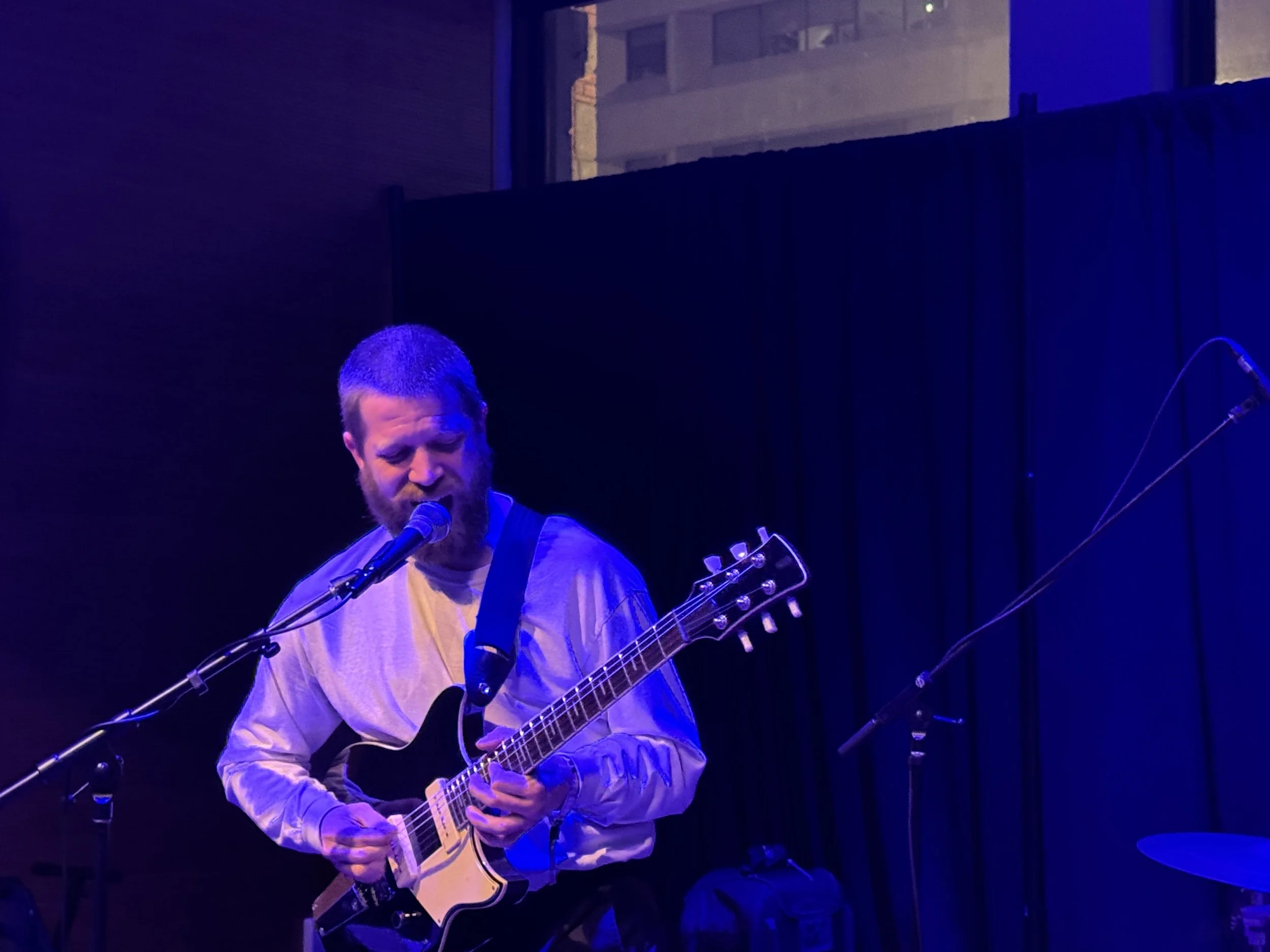
Motherhood is a post-punk Fredericton, New Brunswick. The band consists of Brydon Crain (guitar, vocals), Penelope (Penny) Stevens (bass, vocals), and Adam Sipkema. The population of New Brunswick, according to Statistics Canada, is around 870 000 people in the first quarter of 2026. I was curious about how Motherhood felt acting as somewhat of a representative for New Brunswick, this relatively small part of Canada. “It's fun”, says Brydon, “because I think people might have an idea of the type of music that comes out of the East Coast right? Also, because there's not as many bands in this scene touring out of there, we kind of, well… We joke that we're the sound of New Brunswick music whether they like it or not.” Why would they prefer Fredericton over a larger, and nearby metropolitan area like Toronto or Montreal? “I think it's about the lifestyle. Like, the Maritimes moves slow. Even if you're in a city, it moves a lot slower than if you're in any other sort of part of the country. And, life is a little bit more simple there. But it's really community driven and I think a lot of people, in the pandemic, realized that they kinda wanted to get the fuck out of a city. And we were like, ‘Yeah, great idea,’” says Penny. I asked Penny to expand on what she meant by the fact that New Brunswick “moves slow”, she said, “Hustle culture doesn't really exist [in New Brunswick]. Like, you know, a lot of the artists that come from New Brunswick often do move to bigger cities. And I don't know, we've just seen a lot of our friends have to get, you know, two or three jobs. And like just having to hustle so hard to stay alive, and it can really put a lot of pressure on what you're able to do creatively. When we spend time in bigger cities it's like there's a sort of like a transactional element to what's happening. It's business, you know? It's capitalism. And that's not the way that we do things in the Maritimes. It's just chill times.”
Most of Motherhood still works full-time when they’re back in New Brunswick. Brydon is employed as a maintenance worker at a bowling alley, Penny is a full-time musician currently, but says she bounces back and forth between that and part-time jobs, and Adam is a production manager at a biotech lab. “One is interesting, one is just funny," says Brydon. “This bowling alley in particular is, like, they have candlepin bowling in the Maritimes. So it's, like, 10 pins, but they're thin. It's like a style of bowling that's regional to the Maritimes and New England, the state. So the machines are all from the early '60s. They're just constantly breaking because they're old. So, that's most of what I do is just try to keep the machines running.” “It's pretty cool,” says Adam, “He's taken me back there a couple times and I almost lost my shirt one time.” When asked “How?”Adam just said, “Tight, tight, quarters… and a lot of moving parts.” We all laughed.
“I’m curious with the three of you, how does the songwriting work, who does what?” Penny starts, “Most of the songs are kind of led initially by somebody, I'd say. And then we shape it. But most of the music is pieced together, you know, together.” Brydon jokes, “We're at least in the room together, banging our heads against the wall as one.” Penny laughs, “Oh, yeah. Feel like we're all just one giant empty head.”
“We started out kinda normal style,” says Brydon, “Where I would have a song, and I would just be like, ‘All right, let's all play this song.’ And it just kinda sucked. And then once we…” Adam laughs and interrupts, “Take it easy, bud.” Brydon continues, “Once we whittled down to this form of the band I think it became way more collaborative, and everyone was kind of trusted to do their own part. Like, no one's telling Adam what to play on the drums or anything.” Adam chimes back in, “See, this is where I kinda disagree. Because I think I like when someone says, ‘I have an idea for this. What if you did this?’” “It's fine if you like that, but we don't tell you what to play,” says Brydon. Penny chimes in, “But we tell you [Brydon] what to play all the time.” “Yeah, and I don’t love it,” says Brydon. We all laugh again.
In 2025, the members of Motherhood effectively released three records. Their latest LP, Thunder Perfect Mind came in January of 2025, Penny released her debut solo album, Liquid Compactor, with a band of her own (the Pits), and the three of them (plus Keith Hallet) released a country album, DOWN FOR LIFE, under the moniker of Sam Salmon and the Grand Manan Bandits, largely led by Brydon. What made 2025 the right year for these three albums, and how did they know which songs were Motherhood songs, and which belonged to other projects? “It just kinda started happening,” says Brydon, “And then once we realized that we could put out three albums in a year…I know I personally got really into that idea. And then even as we were releasing Sam Salmon, like, there was a point where our manager was like, ‘Mm, we might need to push it to 2026.’ And I was just like, ‘Hell no, no fucking way. We've been working for this!’” Penny starts, “They [the albums] all sort of have a different backstory. Like, obviously Motherhood is the through line and our priority at all times. The solo projects are fun, but they're a different sorta thing. I started writing my record when we were on tour in 2023 through the States when we were on this horrible tour to South by Southwest, and it was 12-hour drives every day. And our van was breaking, and it was just like there was nothing to do but just stare into the abyss. So I started writing my record then. Brydon's record [DOWN FOR LIFE], a lot of those songs have been around for 10-ish years. They kind of laid dormant for many, many years, and then we sort of started picking it up a little bit last year, and it kinda got the momentum back going. But I think really it's just a coincidence that they all sort of happened together.” Penny continues, “But it is sort of like we're at that crux in our lives, too, where we're like, ‘Okay, are we able to transition to being full-time musicians? And what does that have to look like?’ So it's more music, and Motherhood can't play Fredericton every month and make money. But if we have three different projects on the go, then we're like, ‘Well, there's three times as many shows we could play in the same city.’”
“Who are each of your biggest influences, in terms of songwriting or just on your instrument?” Adam starts, “I love Captain Beefheart. It was a big thing for me being in my 20s, and discovering this weird back-asswards musician who just made records that people hated. You know, the fans are there and those people, they really love what he did with his body of work and like… He made some mistakes too. But he has a really interesting fingerprint musically that no one has replicated.” “A lot of the stuff that I listen to is very wordy or lyric centric,” says Brydon, “I like The Pixies or people that yell a lot. And I think that comes through.” Penny speaks last, “Oh, I don't... I can never recall music that I like on the spot. I don't know.” She pauses for a second then says, “I would say there's like Beach Boys, Zappa, Beefheart, and Deerhoof are sort of like the triangulation of most of the music we like.” Brydon chimes in, “I think Penny brought any sort of sophistication that we have to the band, because she was trained on piano, knows theory and stuff. Whereas like me, and I'll speak for us [Brydon and Adam] we’re a little bit or more or less…” Penny interrupts, “Boneheads. Absolute boneheads. Yeah, rubes.”
Motherhood was playing in the CKUA building that night for Winterruption in Edmonton, and I’ve started to feel bad for them because it seems the last few times I’ve seen them here, they’ve been sick. Super sick. It’s just some sort of curse. However, despite their sickness, their performance that night was amazing. The harmonies were tight, the band was together, and they were as charming on stage as they were during the interview. They’re ripping through Europe right now, make sure to catch them if you get a chance.