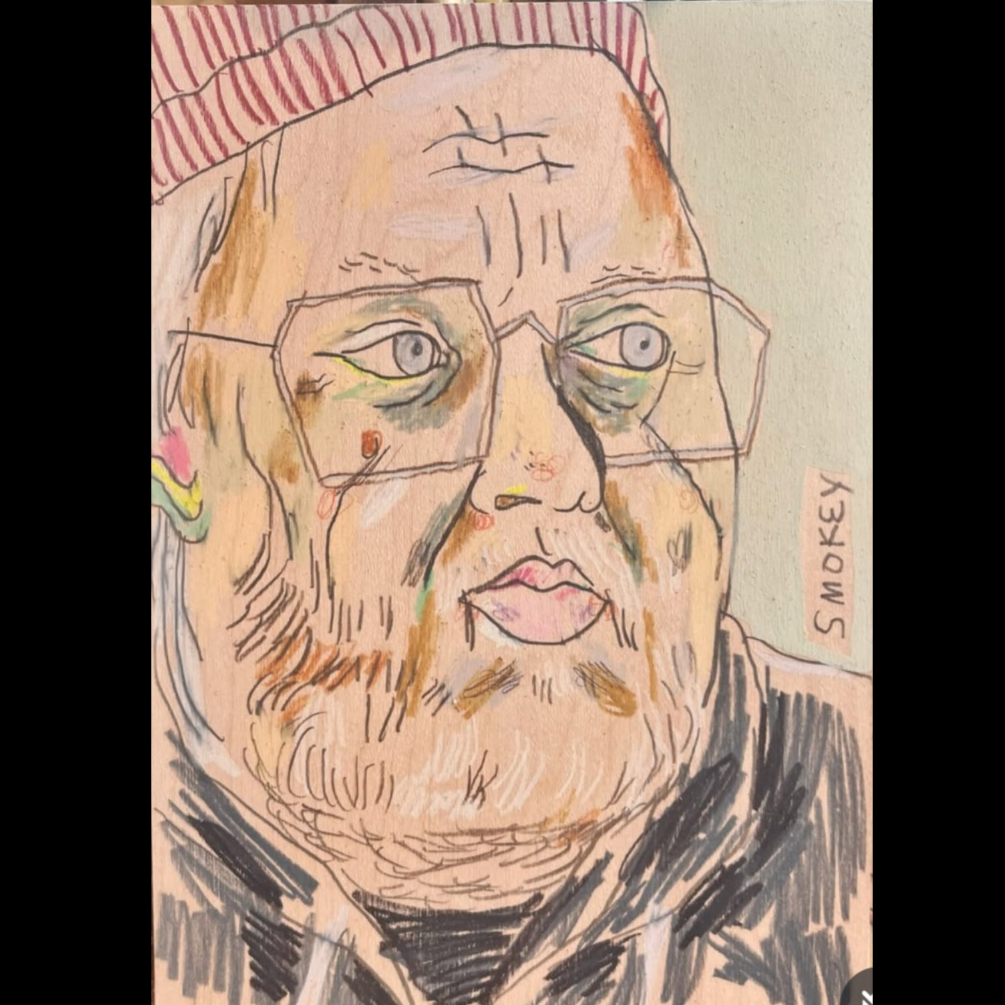
Fulfilment - Husky House

Revolution Winter
Released on May 10th, 2025
Husky House is the newest full-length album by Fulfillment, and their first on Revolution Winter Records. Revolution Winter and it’s cassette only sister label, Bart Records, are responsible for releasing some of the best and most important records in the history of Western Canadian music. They are also both run by Fulfillment frontman, Kevin Stebner.
Stebner is a songwriter, musician, record label owner, poet and visual artist based in Calgary, Alberta. The Stebner musical universe covers 20 years and includes projects like Draft Dodgers, Prepared, Stalwart Sons, Cold Water, and his newest project, Fulfillment. Like the John Steinbeck catalog or the Alfred Hitchcock filmography, Kevin has a unique style that runs consistently through his bands and his records, despite stylistic differences.
A lot of these projects are rooted, to some degree, in Matlock Records style math-rock. They all have Stebner’s unique lyrical style, which is fascinating and literary. He also has a unique vocal style that yells, hollars and barks, but rarely reaches a scream. It is a talk as much as a sing.
Husky House is also a departure from previous Stebner projects. It’s his most confident project to date. It’s secure. It has nothing to prove. It seems to discard the idea of expectations, both as an album and within each song.
The album opens with “High Tide”, a poem set to music. The guitar drives aggressively behind the words, then rings out beautifully over a bubbling baseline. There is no lyrical repetition until 2/3s of the way through the song. The repeated line “Look me in the eye and submerge my head” is sad, beautiful and powerful.
Earlier, I mentioned the literary lyrical style. Let’s get more specific. It isn’t literary in the polysyllabic, English Major trying to impress a date way that like, The Decemberists are. And it’s not the general bookishness of Morrissey. It’s not the boozy world building of Craig Finn or the simplistic love poems of Daniel Johnston. Stebner flirts with some of these things sometime, like taking a famous lyric or idiom and flipping it on it’s head. Thousandaire opens with Money for something, and nothing is free. Knife in the River tells us that if you hate something, set it free. For me, the literary aspect is how Stebner plays with meter, linelength, rhyme scheme and rhythm. It results in a mathematical lyrical structure. It is impossible to predict what comes next and creates a tense and dynamic listening experience. It sometimes prevents the songs from being truly catchy, but makes them far more interesting.
Some of the highlights on the album are the title track, “Husky House”, which is about being a touring band. Stebner sings Measure distance in time and time in songs. as his guitar dances, creating flesh over a skeleton of steady, pulsing bass and drums and a keyboard tone that I assume comes from producer Lorrie Matheson. “Any Better” is a two minute, moody little pop punk song. “Ruinseeker” is a post-punk anthem that will be stuck in my head forever.
To focus exclusively on Kevin is unfair. Steven Duggins’ drums make structurally complicated songs seem simple and holds the whole thing together. David Tkach, formerly of the incredible bands Big Knife, Little Knife and giant sons, plays the perfect foil for Stebner’s guitar. It is the lungs of the songs, breathing steadily while chaos reigns around it. Lorrie Matheson’s production genius lies in giving each album exactly the treatment it needs. Every part of Husky House sounds crystal clear, but never at the expense of grit, noisiness and vibe.
Husky House is math rock all grown up. It’s more thoughtful than angry. It’s wise and solemn. It should be hung on walls and played in bars. It’s my favorite part of the Stebner musical universe to date.