
The Talbot Trail Boys - S/T
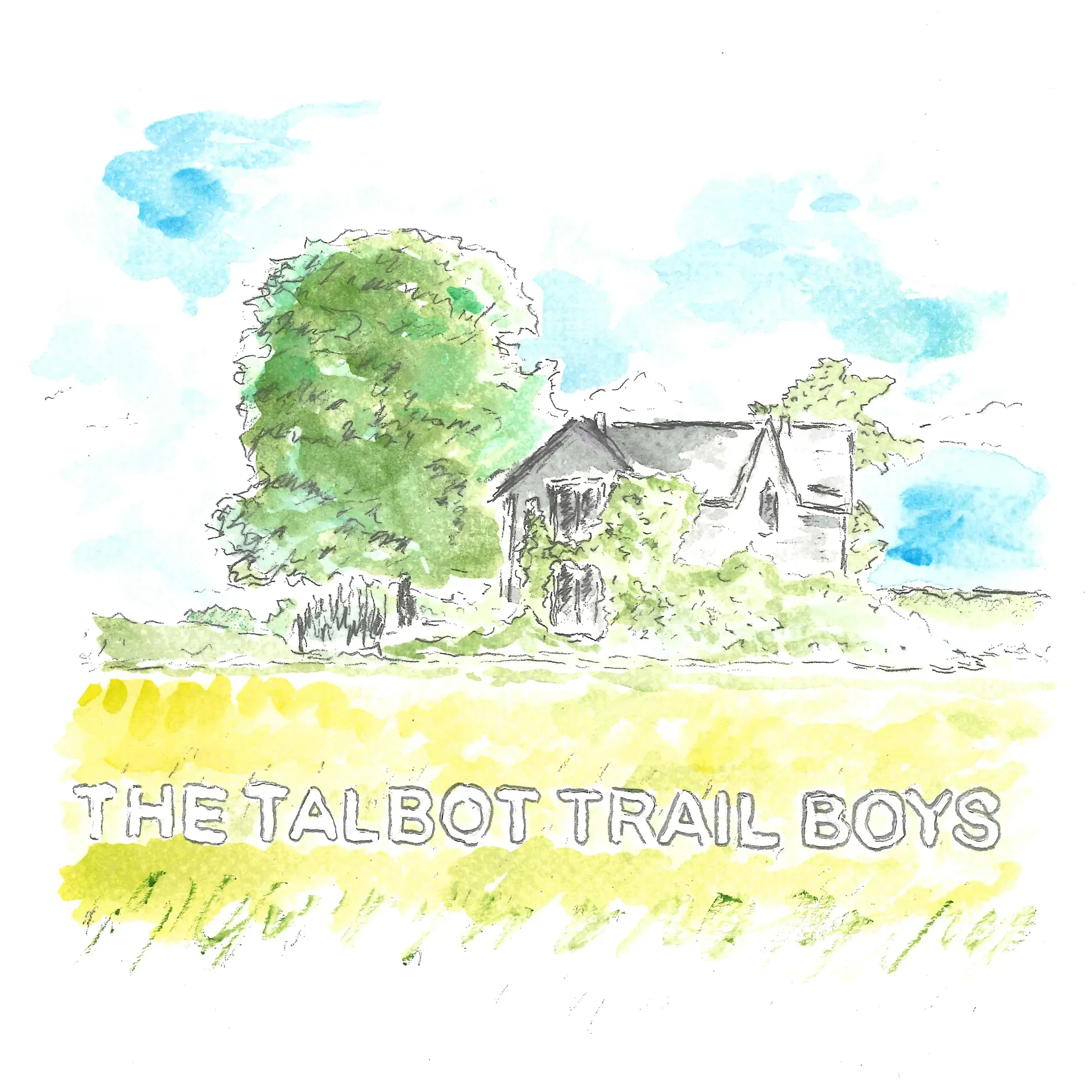
Self-Released
Released on March 9th, 2026
Henry Adam Svec is a national treasure creating national treasures. Through the last twenty odd years of his wild and careening career, Svec has used many aliases and monikers (Peter Mansbridge and the CBCs, Staunton R. Livingston, The Boy from ET) to make music that is as much performance art as it is, well, music. At first, each new project seems singular and miraculous, appearing like a dandelion from a sidewalk crack. Svec is not one to connect the dots for his audience, and it’s not until you inspect more closely and see his name listed coyly in the credits that you see the throughline. Because he never stays in one lane too long, reviewing his work can take some sleuthing and head-scratching; just as, I suspect, he likes it.
Svec’s work tends to blur the lines between historical records, local lore and absurdist comedy. Take, for instance, the CFL Sessions, in which Svec “discovered” a long-lost collection of songs recorded by Canadian Football League players in the 1970s. But, dear reader, it’s an elaborate ruse! The songs in question? Svec wrote and recorded them - not in the 70s, but in the late-2000s! From this collection, we get such memorable tracks as “Song Written Upon Getting Cut by the Argos” and “CFL Seasons In The Sun”, a fantastic quasi-cover of fellow Canadian Terry Jacks’ 1974 smash hit.
Don’t get me started on LIVINGSTON, a project in which Svec “created an artificially-intelligent database of Canadian folklore” that generated new Canadiana folk (noted: 10+ years ago, well before AI started producing musical slop). Once again, LIVINGSTON was an elaborate ruse, and the songs were, of course, composed and performed by Svec and his friends.
Though tempting to spend my entire word count just describing Svec’s elaborate prior undertakings (or pranks?), his most recent project, The Talbot Trail Boys, is the reason we’re here. The Talbot Trail Boys firstly takes the form of a “historical musical mystery” podcast that follows a “folklorist and song collector” in his quest to uncover the mysterious origins of the Talbot Trail Boys, a band of brothers who recorded only one album in the 1990s and seemingly disappeared. The narrator (played by Svec himself) discovers a dusty copy of their vinyl record at a yard sale near St Thomas, Ontario, and the rest is history (or, more accurately, historical fiction).
The 6-part podcast, Souwesto Gothic, chronicles the folklorist’s forays into dirty barns, provincial archives, and hospital beds to discover the truth about the album - and the fictional family - that so deeply tickled his fancy. As an avid podcast consumer, I highly recommend it to anyone interested in Canadiana, “true” crime, or…performance art?
I won’t get too far into the podcast, but it’s a fun ride, with as many twists and turns as the Talbot Trail itself. The characters (all voiced by Svec’s friends and Ontario musicians) are as colourful as the autumn leaves, and add comedy and tragedy in equal measure. In the final episode, our beloved folklorist and song collector announces that he has received the proper permissions to share an excerpt of the album with the listeners. The podcast finishes by playing 4 complete tracks, giving the listener a moment of intentional pause to validate and correlate all we’ve heard up to this point.
Months later, Svec released the full Talbot Trail Boys album, 9 scruffy indie-country tracks that perfectly illustrate and augment the podcast’s winding journey. In case you’re confused (and I wouldn’t blame you), these tracks weren’t actually written by the Talbot Trail Boys, the fictional band around which the podcast circles, but by Svec and his friends.
The songs are great, really reflective of the area’s sonic trademarks and true to how they had been described in Souwesto Gothic. Henry Adam Svec’s voice is endearingly shaky, like Neil Young in his prime, and the song styles and tones aren’t unlike Comes A Time. Delicate tracks like “We Sang Auld Lang Syne”, allow your mind to wander down those country roads, while bouncier numbers like “Bury Me Under Lake Erie”, evoke some of the wounded pride that come part and parcel with a backwoods way of life.
The album ends with two interesting cover choices. First, a charmingly lazy take on The Eagles’ “Take it Easy”, followed by a more traditional rendition of “I’ll Fly Away”. When considered together, these tracks seem to mark the sonic pendulum swings of the album, one quintessential soft rock while the other firmly rooted in the trad-folk of the 1930s.
I can see why the folklorist and song collector fell in love with this mysterious record. What the songs lack in frills, they more than make up for in self-possession, each bar delivered with the measured confidence of experienced players that aren’t afraid to let things get a little loose, a little sparse or just dissonant enough to make a point. The rip-roaring fiddling work of Nathan Smith ties the whole album together, authenticating the tale while your toes tap along. Unsurprisingly, the haunting vocals of Misha Bower are another stand-out, which tends to be the case with anything she touches. Another national treasure!
With a definite scrappiness and slow country swagger, the Talbot Trail Boys is the perfect bridge between a tall tale and a real contribution to the course of Canadian musical history.
With the many layers of “otherness” to this album - the nearly 6 hours of podcast audio, fictional narrative building, and eventual delivery of the album as an implied by-product, this project begs the question: does Henry Adam Svec consider himself a musician at all? Or is music just one tool in an ever-widening arsenal of creative disciplines? It appears to me that this folklorist is more concerned with storytelling and myth-making than format or medium.
With tongue firmly planted in cheek, Henry Adam Svec creates parallel Canadian universes, ones in which football players write love songs, AI-bots compose remarkable Canadiana, and rural families withhold secrets from a folklorist and song collector. In his many worlds, history melts into fantasy, tragedy melts into comedy, past melts into future, and music is the only constant. Maybe there’s a bigger metaphor there, but I won’t connect the dots, and neither will Henry.