
In Conversation: Caged Animals
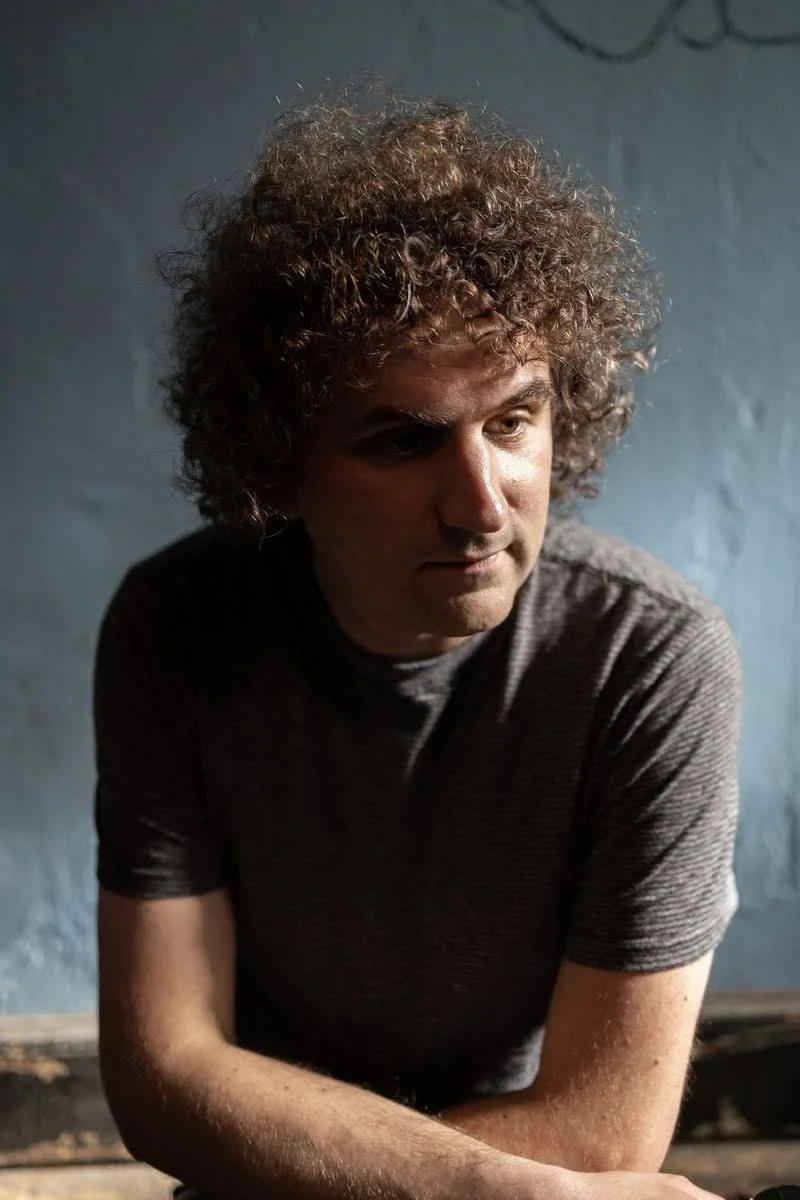
Photo by Magali Charron
Caged Animals is the music project of Vincent Cacchione and Magali Charron. The pair met in the late-night frenzy of NYC’s mid-00’s anti-folk scene. Vin, the budding songwriter, and Magali the photographer with violin-chops.
Since 2020 they have called Sackville, NB home and have recently released Make Strange Friends on You’ve Changed Records. Caged Animals’ music sits at the intersection between folky lyricism and the DIY charm of indie-rock.
They have toured internationally, and shared stages with Julie Doiron, DIIV, and Blood Orange, and Vin’s music has appeared in film, television, and acclaimed podcasts: he recently composed the score for Audible’s sci-fi series The Space Within.
On their new album, the duo worked with Jon McKiel to capture their intimate, story-driven songs on his Tascam 388. The music pairs the blacklight anxiety of Nebraska with a kaleidoscopic musicality akin to Mutations. The album closes with an unlikely final track, a thirty-minute absurdist radio drama starring Larry “Ratso” Sloman and Magali’s 93-year-old grandfather Bertholet, reflecting Vin’s inter-disciplinary work in music and audio fiction.
I visited Vin in his home studio on a chilly January day to talk. We dug into his journey from New York to Sackville, anti-folk, the 30 minute play that concludes Make Strange Friends and, of course, the new album itself. We also veered into topics like stories as hope and music as religion.
Steve: For those of us not in the know, can you draw us a brief map or a timeline of how you started out in New York and ended up living in Sackville, New Brunswick?
Vin: Totally. Magali is from Sackville and we met in New York in the mid-2000s. She had come down with her then-partner. They had a band together, and they were playing at The Sidewalk, which is a club in the East Village that was solely dedicated to alternative folk music. Anti-folk is the genre most associated with “Sidewalk”, and the scene kind of revolved around an open mic that would happen every Monday. It was the most popular open mic in New York City. Hundreds of people would come and sign up. It was like a zoo there and you'd be playing in front of hundreds of people. You might have to wait all night for your turn and it would go from 6 p.m. until 4 a.m. It was a really amazing place to come of age musically. You would get up there, play one song and then hear like 150 other people play their song. It was a great exercise in community building because you'd hang out all night with people who are doing what you do.
I met Magali playing one of those open mics. I played a song that night that I knew was a good one, I killed it. It was one of those nights where you go up with something you feel totally confident about. I got off stage and I heard a pair of feet following me down the stairs. I look up and there’s this pretty girl behind me. She's like, “your song, man. Your song is the shit. That's crazy, man.” That was Magali and that's how we met.
Six or so months later, she was doing a photography project on a bunch of songwriters from “Sidewalk” where she was going to cover the walls of the venue with photos of the performers. She invited me to be a part of it and she took my photo. We hung out all day and really hit it off. I was like, “oh, I totally like this girl. She's so awesome. I love this girl”.
So we started to date, that was back in 2007, and then around 2008 she wanted me to come meet her family. We drove up to Sackville for the first time and the whole way we were listening to Julie Doiron and Chad VanGaalen and she's telling me all about Sappyfest and the early Sappy performances that were happening right around then. I arrived in Sackville and it was like this oasis in the middle of nowhere. I had never been someplace as remote as New Brunswick. Growing up in Jersey, spending ages 18 to 37 in New York City, I'd never really been to any remote places. There was a magic to that for me, to the expanse of New Brunswick and the beauty of nature here. The very first time we visited, Magali drove me way out to Rockport to meet her grandpa. He was like, “you smoke weed?” I had hair down to here and I was wearing a tunic. The answer was clearly yes. A second later he's twisting up a joint for us and I was like [to Magali] “this is your grandpa?” He was like, “you want to write poetry with me?” So we wrote poetry together.
Steve: Amazing. So, your new record. I'm always interested in the overall theme and concept of projects. Where did the idea for Make Strange Friends come from? How does it all fit in your head?
Vin: What always ends up happening with my records is that I'll just write songs and I write a lot, usually. On this record, I probably wrote 100 songs and these are the nine that are on the album. Usually I'll write a song that really strikes me, where, as you're writing it you're like “oh this is the one I was looking for,’ like the song is magnetized or something. I wrote that song “Crow” and I had that feeling. I wrote it a month after we moved into this house, in this room. I kept writing and once I had a few that felt like they were talking to each other then I started to ask myself, “what is this all about, what are these songs about, why am I writing this?” It took me a couple years to realize what the theme was but once I had those couple of songs that really talked to each other, then I had the secondary idea to write a play in that thematic world and that informed the last bits of the songwriting. It's not an efficient way to work, but it’s creative and kind of mysterious, I thought.
Steve: Yeah, that's what I was going to say. There's real magic to that. First of all, the magic of songwriting in general is totally divine to me. When you talk about a song that feels magnetized, that’s something special. There's a real kind of alchemy to having all of this art floating around in your head - a hundred songs, a radio play, and then distilling it down to something cohesive..
Vin: It's fun to have that pan out. For this record, a lot of these songs I wrote in 2020. They're older, relatively, from when they were released but it gave me some time to figure out which ones were still resonating.
Steve: You said that “Crow” was the first song that grabbed you. Did that inform the crow on the album cover?
Vin: Yeah, Magali's photo of Jon McKiel's driveway in Baie Verte illuminated by the rear light of our car and the two characters that are in there - this demonic bird who's freaking out this very friendly ghost. I think they're kind of avatars for the theme of the record, of just finding meaning and discovering new friendships. I was writing these songs having come from a really rich family and friend circle and having never really left the 20 mile radius of northern New Jersey and New York City during my life. Then to come here and basically start over again at 37 was a little bit intense. It's hard for me to not see that inside of the songs.
More broadly, it’s about this era we're living through of social disconnection that’s exacerbated by phones and social media. All this stuff is taking us away from each other and asking us to define ourselves rigidly by fitting our identity into the algorithmic flow. That's what the play is to me - these two old guys who are both sort of high on their own story, on their own version of themselves, who encounter each other and they're judging each other a little bit. They're being a little pretentious.
Steve: The play is amazing! I listened to the music first and I didn't get around to the play on Bandcamp until later but it just completed everything for me to have these two old guys, Magali's grandfather, Bertholet Charron and your friend, writer and author Larry “Ratso” Sloman, meeting each other at the end. It was very powerful.
Vin: Yeah, neither Ratso nor Bertholet are exactly those characters even though I’m drawing from both of their lives very heavily. They’re the two male elders of my life. My dad died when I was 19 years old so I don't have that person in my life but, to me, Bert is one of them. I met him when I was 24 so he's been that kind of elder in my life for a long time. Similarly, Ratso is that guy in my life too. Plus, they're both actors with terrific voices and I had this idea because Bert is on my last two records doing little spoken word pieces. He sings a lullaby with Magali on the previous record and before that he recites an english translation of an old french fable so I knew I wanted to incorporate him in the record. Bert and Ratso are both aware of each other via me so they have a level of curiosity about each other and as I began to write the play I was thinking, what if Bert’s just talking to Ratso? But why would he be talking to Ratso? That's where the Bay of Fundy really played a huge role.
There's this amazing natural force a kilometer away and I feel like it's underneath all of this for me in terms of inspiration, the natural landscape of this place where we find ourselves is really powerful. I thought, what if the bay pulled Ratso out here? What would that story be? I had visited Ratso only a month before I started writing the play and he has been living out in Rockaway Beach in Queens. He was like “let's go for a drive,” so we went and he's like “this is where I take the ferry and this is where I get my bagels.” I was picturing that ferry, imagining Ratso getting on this boat to go to the city and that's where the spark of the idea came from. What would happen if Ratso got on that boat and something happened, we're not sure what, and he wakes up on a raft where, all of a sudden, he's being pulled in by the Fundy tide and that's how he meets Bertholet! Once I got them talking, they wouldn't shut up! I just kept typing and made up this one-act play.
Steve: It's obvious that you really know them both because it sounds authentic. They're both so endearing. I love the writing, it's rife with allusions to the Bible, Greek Mythology and Acadian history, among other things. I hope you'll appreciate this, but I've been part of a book club for the past year or so where our goal is to read books that give us some kind of hope. There's a genre of science fiction in particular, dubbed “hopepunk” that gives us a story where we've solved some of the problems that exist, where we can leave the book and the book club sessions being like, “okay, there's some hope.”
Vin: That's beautiful.
Steve: It's great. It's fun. But it's hard to find stories that end up feeling more hopeful than distressing. It's really difficult to find those books. After listening to your play, I thought, this might be one of the most hopeful stories that I've heard in a long time. I just love how these two characters come together and find some common ground. It really made me feel that, at the end, right in the face of an apocalypse, there’s this idea of connection and making friends, of finding common ground and commonalities in culture and lived experience. I think it’s a salve to anxiety and can help our malaise. I feel it from those two.
Vin: That’s cool. Thanks man. That's where I’m at with it too. To be honest, even though we just released this record, I'm starting to think about whatever comes next and I'm just going to go further in that direction because I feel like it's actually our job as artists. Even if we are just humble artists not reaching tons of people yet, we have to do our part to change the cultural story because the story right now, it's not helping people. It's not helping us lift our society into something better.
Things are scary and uncertain and we're all feeling it. The whole world is feeling the uncertainty. When Donald Trump goes and steals the fucking leader of a foreign country, that doesn't give anybody hope. I mean, maybe some Venezuelans feel hope from it, I don't want to discount that, but these times are scary. They're uncertain and we're all feeling it. The kids are feeling it. They know big things are happening right now that we can't control. But what can we control? We can control the stories we tell. So I definitely have a perspective. I strongly feel it's our job as artists on whatever level, wherever you are, to do something to change the culture. That's the whole purpose.
Steve: Yeah, I love that. The record is full of these little vignettes, stories and characters. You're such a great songwriter and you have some strange characters on this record. Strange friends. How did you come up with these characters and stories?
Vin: “Alligator” comes from our dear friend Neil Ruff who was a really important person to me and Magali. He's one of Magali's mentors in the world of photography. He's maybe 10 or 12 years older than us but we love his work and he's been a good friend for a long time. Neil moved down south and I was picturing him down there. He's the kind of guy who's like, “I don't care if you're a Donald Trump supporter. You're a good dude. We're going to be friends.” He's willing to do that work as a person. I find that admirable. So I wrote that song five years ago. It was when we weren't sure if Donald Trump was going to be president again in 2020. The election was still going on and I was just picturing someone like Neil in a McDonald's parking lot and this F-150 pulls in and it's a “Trump guy” and they just have this moment and talk to each other. It's quite a short song lyrically so the story is more implied than written down but there's a little insight into their philosophies and their ways of seeing the world.
“Rattle the Quiet,” “Crow” and “Big Bad Wolf” all feature the same character at three different phases of life. I was thinking a lot about Springsteen’s Nebraska and the use of criminals in that narrative. That has been a favorite record of mine since I was a kid so I was thinking about that and how that might apply to the social problems of our times. I developed that character on “Crow” and then I went back in time with him and then forward in time. It’s not presented in narrative order on the record.
The character in all three of those songs came from the inspiration for “Crow.” I was just looking out the window and I saw a crow sitting on the top of a tree and was asking myself “who else saw the crow?” I imagined somebody in Dorchester, at the jail, seeing the crow and then I had the character.
With “Balloon Heaven,” I originally had a song called “Swerving Into Heaven.” It was one of those songs where the melody was really strong. I had the line “swerving into heaven, turn up to 11,” which is almost a throwaway line to me, not one that screams “keep it in the song.” But then our friend from the anti-folk scene, Spencer Chakedis, died. I was writing this song and it was literally the same day he died. His recording studio was called Balloon Heaven. I don't know why. He was a recording engineer who did a bunch of the Jeffrey Lewis records and a bunch of cool stuff. I just put it all together and then I infused aspects of Spencer into the lyrics of the verse.I figured what better way to pay tribute to him.
Your observation about balloons I had never thought of but that's really cool and maybe on a subconscious level there's something there but it wasn't deliberate. With “Inflated” I was thinking about the comedy of being a man where you have all this air to give.
“Blood Moon” I wrote before we moved here. That's a love song I wrote for Magali. It's an imagined version of us being young and living under the JMZ train in Brooklyn. The train runs above ground, and the tracks are just covering the street, so you're just constantly in the shadow of the tracks. People live down there and it's horrible because it's so loud but it's also kind of awesome, kind of romantic in its own way. I just had some fun with that one and grabbed some images from that era. I wrote it in 2018 or 19 so it's the oldest song on the record.
“Radio Down” is an alternate timeline version of me and my dad, actually. My dad was a stand-up comedian, artist, and hand engraver. He worked for Cartier, which is the famous jeweler in New York City, hand engraving their jewelry. He is a super influential person in my life, my dad. He had a really bad drug and alcohol problem and he died young at 50. That song is an imaginary alternate reality where instead of dying, I'm picking him up from rehab and we're just having this uncomfortable drive with one another. We’re not sure where things might go, but we’re hopeful. I don't know how I arrived on that one, lyrically. I had the riff first, and then... I don't remember. It just kind of all came out. Yeah. It all just came out. My dad... Every one of my records has songs about my dad on it. It just keeps coming out. For a while, I was a little embarrassed of it. I had some criticism earlier on in my career, like a year or two after my dad died. People would say “your music is so depressing, man.” And I was just like, “fuck, well, I hear you, but I'm just honestly reacting to my life and writing about it. It wasn't enough to scare me away from being honest in my work though. So, pretty much every record I find my dad somewhere in there.
Then there's “Building a Monster” which I wrote early in the pandemic, maybe a month after living here. The song is about the uncertainty of all the pandemic stuff and the Trump stuff and I was starting to learn a little bit about AI which hadn't really quite hit yet but I was thinking about it.
Steve: Having listened to the play it’s fitting how “Building a Monster” flows into Ratso washing up on shore. Whatever that monster is or was maybe had something to do with what happened to Ratso.
Vin: That's cool man, thanks for listening to it. I certainly didn't make it easy for people to listen to it.
Steve: I appreciate that though. I think it's important to have to go dig for something that's not just right there for you. So, we’ve talked about the strange friends, the characters, on your album but you’ve also alluded to making some friends since you've arrived in Sackville. For example, Jon McKiel played a part in making this record…
Vin: Jon's so important in a myriad of ways. I met him in the summer of 2020. Our kids hit it off as the summer was ending just as we were gonna go back to Brooklyn. It had been a magical four months that we spent here but we were just going to go home to our apartment. Then, McKiel invited me here and I was like “this is a dream setup.” He had this tape machine here and I'd been dreaming about a space like this my whole life. I said to him “dude, I would never leave this room if I lived here.” A week later he says to me “hey man, we're gonna move to Baie Verte do you want this place because we're just renting it and you guys should have it.” At that point, we had not committed to staying, we were just kind of hanging out in Magali's hometown but that felt like a sign. Then I started to take everything as a sign. Jon said to me at one point “let me know if you ever want to record some stuff on this machine.” Everything that happened in that small little time frame felt ordained by god and I was going to do those things in that order.
Working with Jon was amazing because I had never really brought somebody in to collaborate quite like that outside the regular people I play with. But I was here and Jon had made this offer so I followed up with him a year later being like “were you serious about that?” He was like “yeah, let's work on something.”So, I showed him “Crow.” We recorded that first and it was just a really cool, collaborative process. Jon would be grabbing a bass or getting on the drums and we just went track for track with each other. We would fill up all eight tracks on his machine, then export and maybe do some mixing. In a couple instances I got a friend to play sax or a friend to play guitar but it's mostly just me and Jon.
Steve: And Magali plays strings, synths and sings and I know Steve Lambke played some guitar?
Vin: The record was just about done when Steve moved to town and he was asking me questions about it. He offered, “let me know if you ever want somebody to play on some of this.” It was the last thing we did. Steve just arrived in town to play on the record and it was perfect timing.
Steve: I often have these little moments on a record that are special, instrumentation-wise. Does anything stand out to you? Like a particular 10 seconds or a little moment where something special happened?
Vin: I have one of those in every song. They're all part of the cool synergy of working with Jon, I feel, because I had the lyrics, the melodies and the chords before working with Jon but the shape of the music was not there.
Every one of the tunes have a lot of Jon in them in terms of the arrangement because I was just bringing him a song to play on acoustic guitar. I showed him a lot of the songs that we didn't record, like probably 20, 25 songs. I'd go over there and play him three or four songs and just look at his reactions a little bit. Like, what are you liking? Do you like any of his stuff? He was being pretty honest and he'd usually say “play that one again” where I would think “he likes this one.” So that was a part of shaping it too. If he grabbed something and started to have an idea then I would just get out my voice memo and track us playing it together that way to make a basis for when we actually started to record it. I love his bass playing on “Building a Monster.” He plays bass on that one, “Rattle the Quiet,” “Crow” and then I'm on bass for the rest.
Steve: The whole album is pretty lush with layers and cool instrumentation. Layers you can dig into and you can pick up new things on repeat lessons. There’s a moment on “Crow” where you brought your friend Jeff in to play sax. That's a pretty mind melting moment as the song moves from the vocals and guitars and they just collide with the sax and it’s like they meet in the air. Then we’re treated to this floaty sax solo. It’s a pretty amazing moment.
Vin: I sent Jeff the rough, like a print directly off the tape and was like, "I want you to be like the crow. I want you to just visualize that bird clearly in a blue sky and it needs to come to life with the horn that you play” and he sent me back a solo that was great. Then, the next day, he sent me another solo and was like “no, it's actually this one.” They're both fantastic.
Steve: You have said in the past “that there's something very beautiful about a band that doesn't earn its whole living from music, continuing to make music. It's a different kind of commitment. It's a different kind of faith. And it's my religion.” Do you remember saying that? It really resonated with me. I mean, I think it's obvious from talking to you but I want to know, does that still hold true for you?
Vin: I definitely relate to it still.
Steve: There's something special about it.
Vin: I think that there really is. I think it's just what folk music is. It's made of that exact thing. It's made by real people. Living their real life. And it's not really intended as a product first and then art second. It's art first and then, is this a product? We don't know.
There's something really cool about the era when we grew up, where music that has a folky or artistic quality might actually be the biggest thing ever. Then there was like, 20 solid years where things like that happened all the time. Now we're living in this different kind of socioeconomic and technological reality that hasn't created those opportunities for people and it certainly has fucked over our generation in a pretty huge way, I find. I know way more insanely talented musicians who don't make any living or much of their living from music. But I do think that when we pan out on this era, we'll notice that in the music. I hope some of it gets remembered. I hope some of it gets digested by the culture because there's certainly a lot of beautiful stuff happening in the margins of all kinds of genres and places. It's actually a great time for music, but it's not an awesome time to be the musician making it for that reason because the economic opportunities are not really there.
Steve: You said it's your religion to make music although it's not your paying gig. I can hear it in everything you say. That story of how you just started taking everything as a sign - the tape machine and what led you to record with McKiel. In the studio you had dozens of songs but you pulled these nine out of the ether to work as a whole for this record. That is faith. That's religion when you're relying on something that you can't put into words, and you're just pulling from the abstract. I'm not religious at all, but I am religious about music and about the idea of where music comes from. How you get something from nothing and everything that happens in between? It requires a leap of faith to go there, you know?
Vin: There's a deep amount of mystery to what we do, connecting with the intangible world. It's real. It’s like we have this weird line into that world doing what we do, speaking through music in this way. It's weird to be the conduit for that when it happens. I think maybe we can take away some of the pain of not having religion because whatever spiritual thing that draws people to music, you've got to assume that all people are made of the exact same stuff, they just have an inkling to satisfy it some other way. I'm glad that I’m satisfying it this way and not stealing money from people. I imagine all the billionaires of the world and wonder “where are you getting the joy of life, where are you getting the wholeness of life, where are you seeing the connectivity of the world?” Art is certainly something that I need, that you need and other people need…
Steve: What's next for you and Caged Animals?
Vin: We’re playing Shivering Songs in Fredericton on the 24th of January. And then I want to book a couple of intimate shows.
Steve: Yeah, it'd be cool to find some new spaces. That's what I've been seeking. Strange is a great word, you know. I've been trying to find some strange venues. And by strange, I just mean, you know, different and maybe like-minded. Not typical midnight bar shows. In finding new rooms to play, I think there's the potential for connection and actually getting to hang out and chat with people and feel better about things.
Vin: Yeah, because people are still out there. We're all seeking it more than ever. I think there might be a renaissance around the corner.