Cosmic Accidents: Patche’s Journey Through Modular Chaos
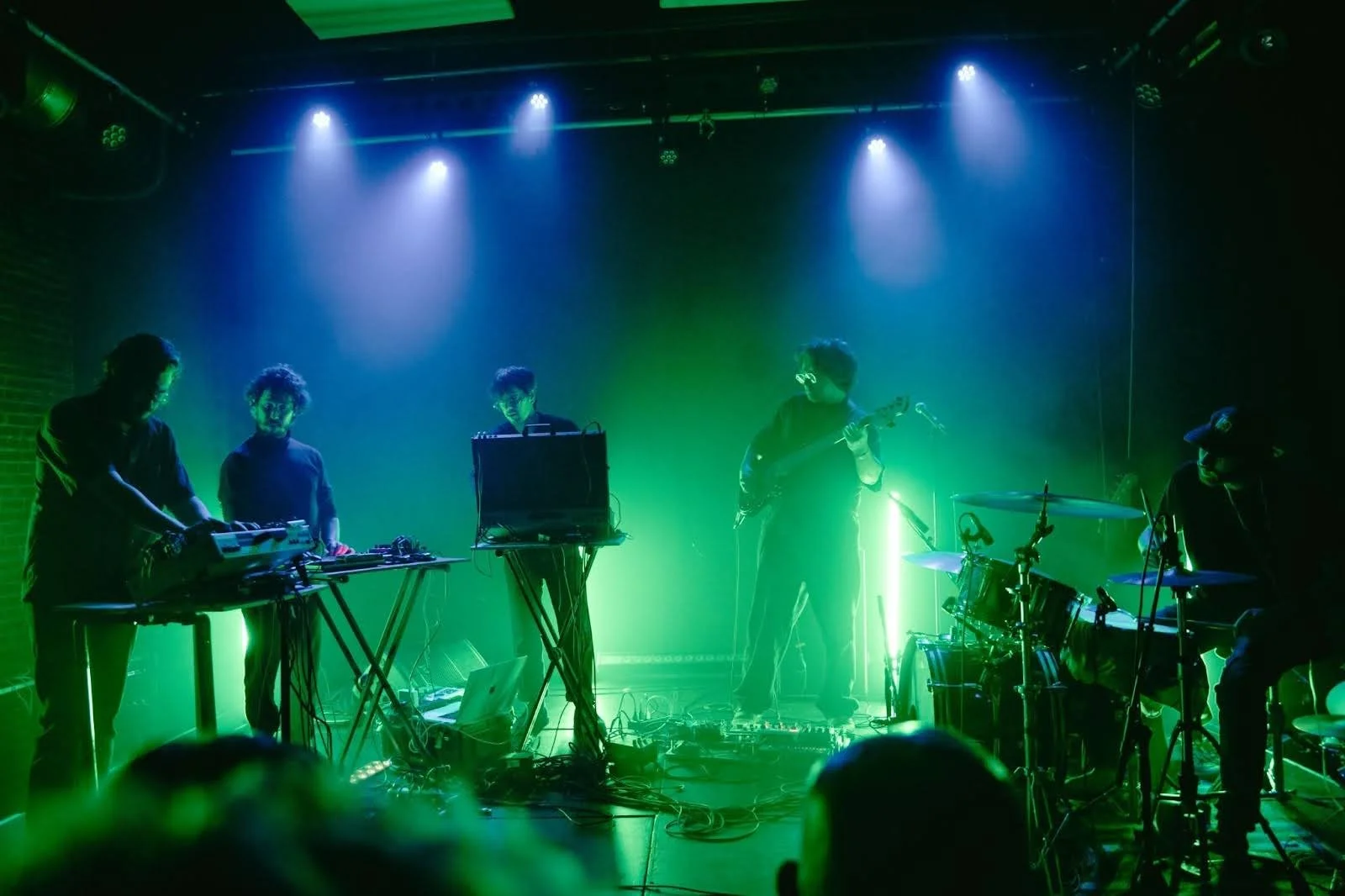
Patche playing at Ausgang Plaza on November 21 during M for Montreal (Photo credit : Camille Gladu-Drouin)
There is something about Patche that is almost supernatural, a kind of happy accident. Whether it's a groovy bass line that appeared by chance, an improvised jam that suddenly transforms a room into a dance floor, or an album cover that seems to unwittingly channel the cosmic legacy of 1970s German krautrock, serendipity acts as a creative force at the very heart of the project. This is perhaps what makes Patche so deeply organic and undoubtedly one of the most exciting electronic projects to emerge from Montreal today. Their momentum in Europe confirms it: something is happening, something is taking shape. Following Patche, from album to album and stage to stage, is like witnessing a continuous process of experimentation, mutation, and revelation. Right before their performance at M for Montreal, Cups N Cakes caught up with the minds behind the modular synthesizers, Eliott Durocher Bundock and Jean-Bruno Pinard. Bundock and Jean-Bruno Pinard.
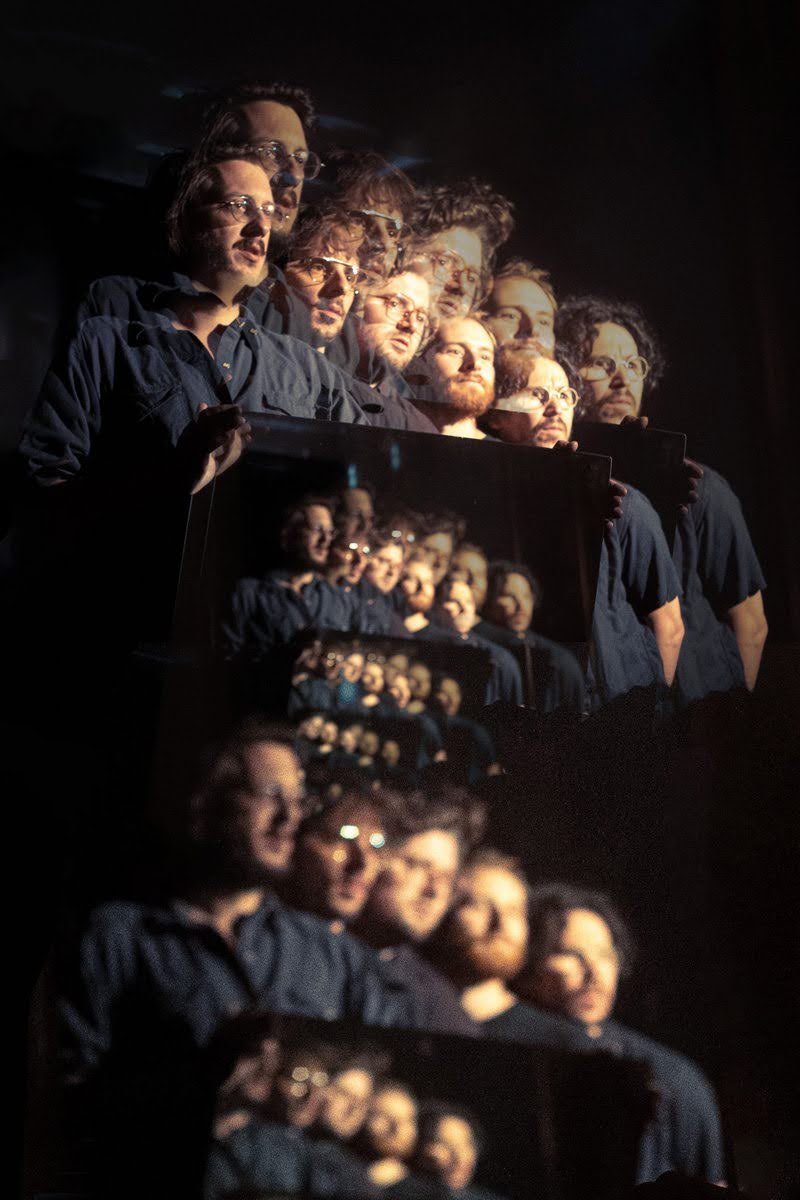
Photo credit: Rose Cormier
Cups N Cakes: I read that there was a kind of heavenly connection between you two in 2018, which materialised through JB's Zombie Life Mon Cœur project. Can you explain how the band Patche came together?
Eliott: We've all known each other for a very long time. I went to CÉGEP de Saint-Laurent with Mandela (drums) and Etienne (bass). I met Lévy (harmonica) who was working as a soundman at the Ô Patro Vys bar. Etienne and I were part of the band Caltâr-Bateau and we all met JB at that time.
JB: I was working in a studio at the time and recording bands for free to get some experience. I recorded Caltâr-Bateau and we became very good friends. As for Patche, it really started with Eliott, who was into modular synthesizers.
Eliott: Yes, I started exploring modular synthesizers with my father a few years ago. During the pandemic, I fell deeper into the modular hell. At that point, Etienne and I had nothing to do, so we went to play together in a jam space. I brought my drum machines and modular synthesizers, and Etienne played the drums. We just wanted to jam, and we realised it was really fun. I thought we could continue in the studio. JB was also starting to play modular synthesizers. In the end, we booked a studio to improvise. I hadn't prepared anything, I just had some programmed rhythms. Other than that, we really started from scratch together. We recorded for two days and that resulted in the nine songs on the first album.
JB: Our press documents talk a lot about jams and live sessions. That's true for the first album; that's exactly what happened.
Cups N Cakes: The word “Patche” has a very specific meaning in the analog world. Can you explain the choice behind this name?
Eliott: The name has several definitions, which is what I found interesting. For the first album, it made us think of patchwork, patching things together. The idea of making collages. There’s also the term “patch.”
JB: Because we make patches with our modulars. Patching wires.
Cups N Cakes: You describe yourselves primarily as a jam band. What do you mean by that? How is it different from your other projects?
Eliott: Since it's purely instrumental music, without vocals, it's less about building a rigid structure like you would with a song. For the first album, we just jumped into a kind of jazz jam session, without knowing what would happen. For the last album, there were more established structures. It's more like an almost traditional structure, like a band, even if the aesthetic is very different from other bands. We're getting closer and closer to an almost traditional style of writing.
Cups N Cakes: Given that electronic music is largely computer-generated these days, I often describe your music as “organic techno.” You are also greatly inspired by Krautrock and its “Berlin school.” Which artists and albums from that era do you have in mind?
Eliott: During the first two albums, I listened to a lot of CAN, Harmonia, and NEU. Today, we lean more towards dark techno with artists who generally come from the UK. Surgeon's albums...
JB: Floating Points too.
Eliott: There's also Kraftwerk, whom I saw last year when they came to Montreal. They're the grandfathers of krautrock, but there are passages that sound almost like techno. It's the logical evolution of krautrock.
JB: Electronic instrumentation brings krautrock and techno closer together as two similar styles.
Cups N Cakes: Do you know any contemporary artists who tend to have the same “organic techno” approach as you?
JB: There's LCD Soundsystem, who use modular synths with a full band, a drummer, and a bassist. Caribou also has this approach.
Eliott: Beyond modular synths, what we do isn't far off from a band improvising with synths, drums, and bass. The thing that stands out with Patche is that we play with sequences, without a keyboard. Maybe that's what's rarer.
Cups N Cakes: When you first see a modular synthesizer, you can't help but think of a quantum physics lab or some crazy scientific experiment. If you had to explain how a modular synthesizer works in a few words, how would you describe this instrument?
Eliott: Modular actually means that everything is¸flexible. All more “traditional” synthesizers use modules with a predetermined architecture. With modular synthesizers, it's as if the entire circuit is open. So it's up to you to determine the architecture. You can create your own universe. It's a way of democratizing synthesizer architecture. The first synthesizers were all modular. At the time, Bob Moog didn't know how artists would use these instruments. It was this trial and error that led to the more traditional synthesizers we know today, with a circuit directly connected to a keyboard. They got smaller and more easily transportable... But we could talk about the history of synthesizers for a long time.
Cups N Cakes: Going back to your new album Mode which was released on popop records, it was through improvising on the foundations of the song “Coin secret” that you found your new guiding thread. The result was “Dupré's Paradise,” which became the model for the other songs on the album Mode. Can you tell us about this creative spark?
Eliott: When we recorded the second album, we hadn't even performed live yet. But from our very first show, we could tell that we particularly enjoyed playing the song “Coin Secret.” The audience was as excited as we were, and we immediately felt a connection with this song. We started stretching it out to get people dancing, with a techno vibe. We didn't even realize it. I didn't really listen to techno before that. Electronic music, yes, but not necessarily techno. But I learned to appreciate the nuances.
“Dupré's Paradise” comes from a jam session on “Coin Secret,” which is online, by the way. You can see the song being created in real time (laughs). I was increasing the tempo more and more, and Etienne came up with a bass line that he improvised on the spot, which I love.
Cups N Cakes: We can hear a sample of a woman speaking on this track. Who is it?
Eliott: That's more Lévy's department. I think it's about meditation again. He's our master sampler and yogi (laughs).
Cups N Cakes: You consider Mode to be your first real album. Why is that?
Eliott: I think it's partly because we did several shows together before making this album. With the first two, we didn't know if the songs would translate well live. We realized that it was even more fun to play them live. We tried to keep that feeling and translate it into something more structured.
JB: Even in terms of musical direction, the first album is more nebulous; we were in a phase of exploration. The direction of the third album seems more confident.
Eliott: The aesthetic of the third album is more consistent. There's more intention behind it. We're already working on the fourth, which is moving in a more techno direction.
Cups N Cakes: All of your album covers are designed by the artist Will Dereume. What common thread do you see between them?
Eliott: Will is a school friend of my girlfriend's who comes from British Columbia. He lives in Vancouver. When you look at his art, you notice a lot of eggs and a little traveler character that comes up a lot. Apparently, he had this weird habit of eating six eggs in the morning before going for an hour-long bike ride. I just thought his aesthetic worked with ours. For the last album, we worked with him a bit more, but still gave him free rein.
Cups N Cakes: It's funny because the theme of the cosmic egg comes up quite often in the Krautrock genre. There's even a magazine specializing in Krautrock called “The Crack in the Cosmic Egg.”
Eliott: It's a pure coincidence! Serendipity…